

Optimize the Trivial While Ignoring the Existential in Hospitality? A Leverage Points Analysis

Escaping the Low Impact Loop: How to do Better in 2026?
Sustainability in Hospitality — Viewpoint by Willy Legrand
The starting point of my short feedback here is Donella Meadows" twelve leverage points. I am looking at current hospitality practices and what could be "transformative" (for lack of better word) along those leverage points (LP).
As such the column "Transformative Practices" is where the attention should be turned to in 2026 and onwards.
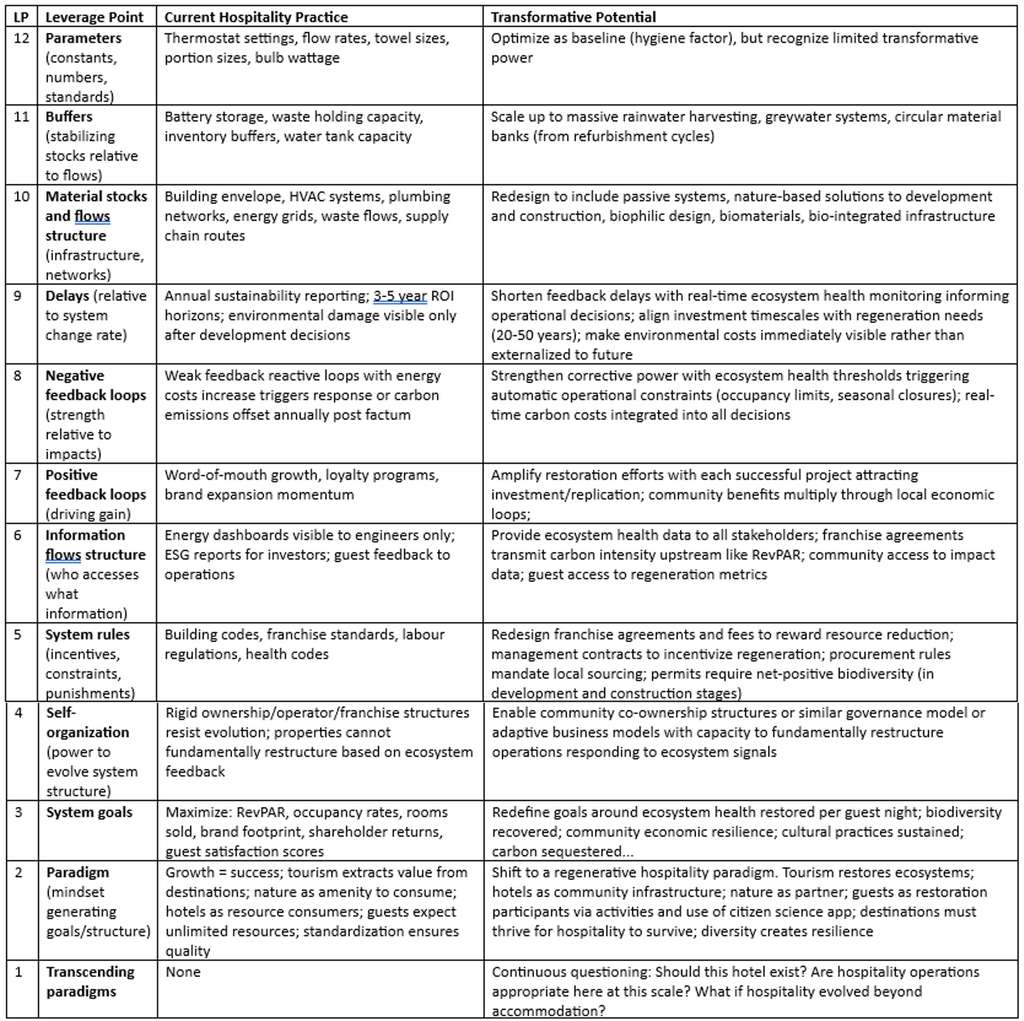
As discussed in the viewpoint, much of hospitality sustainability efforts concentrate at the weakest intervention points. And as shown in Table 1 here below, there is a systematic concentration at low-leverage points (12-10: parameters, buffers, material stocks) while higher-leverage interventions (6-1: information structure, rules, goals, paradigms) remain largely unaddressed.
It's critical to distinguish between 1) planning, developing, and constructing hotels (where decisions create 30-50 year path dependencies, I have written about committed emissions in this sector before) and 2) operations (where many sustainability effort concentrates). Development decisions at LP12-10 create physical structures that constrain operational possibilities – there is only so much an operator can do in a building that"s designed from an energy efficiency perspective for example. Addressing LP6 in development—information flows, rules, goals, paradigms—could prevent building hotels that become stranded assets – something I have discussed in previous Hospitality Net viewpoints.
Critical higher-leverage interventions are more difficult to tackle and at times simply avoided: one key example: changing system rules (LP5) within franchise agreements and procurement protocols that would emphasise sustainability actions; redefining goals (LP3) beyond RevPAR toward ecosystem restoration metrics; or even more critical questioning paradigms (LP2) that assume endless growth compatibility with finite systems.
This concentration at lower and weaker leverage points explains hospitality's repetitive "Groundhog Day" pattern: parameter optimization without systemic transformation.
Table 1: Hospitality Interventions Mapped to Meadows' Leverage Points [1]

There is no doubt the lower leverage points are challenging. It asks to re-think not only a hospitality model, but an entire economic model. And this is our greatest blind spot (in hospitality and generally-speaking). The paradigm—growth equals success, tourism extracts value, nature is amenity to consume—generates all the goals, rules, and structures below it.
Hospitality never asks: Should this hotel exist? Are hospitality operations appropriate here at this scale? The industry cannot hold multiple paradigms simultaneously—cannot simultaneously pursue growth AND acknowledge growth limits; cannot both extract value AND regenerate systems. These are difficult tensions.
Perhaps this is where regenerative hospitality comes in as it operates in fundamentally reconceiving tourism. Drawing on Donna Haraway's concept of assemblages[2]: "No species acts alone; assemblages of organic species and of abiotic actors make history." In hospitality, this is the interconnected web of people, culture, nature, and heritage as one living system—not separate issues to manage independently.
References
[1] Meadows, D. (1999). Leverage Points: Places to Intervene in a System, The Sustainability Institute. p. 6. https://donellameadows.org/archives/leverage-points-places-to-intervene-in-a-system/.
[2] Haraway, D. (2015). Anthropocene, Capitalocene, Plantationocene, Chthulucene: Making Hodge, A.A., Hopkins, F.E., Saha, M., & Jha, A.N. (2025). Ecotoxicological effects of sunscreen derived organic and inorganic UV filters on marine organisms: A critical review. Marine Pollution Bulletin, 213, 117627. https://doi.org/10.1016/j.marpolbul.2025.117627
Escaping the Low Impact Loop: How to do Better in 2026?
 by Willy Legrand