Hotel Yearbook Editorial Guidelines
How to write a strong article for the Hotel Yearbook
Everything you need to write your article for the Hotel Yearbook. Please read these guidelines before you start. They help your view come across as clearly and strongly as possible.
HYB 2027 Annual Edition
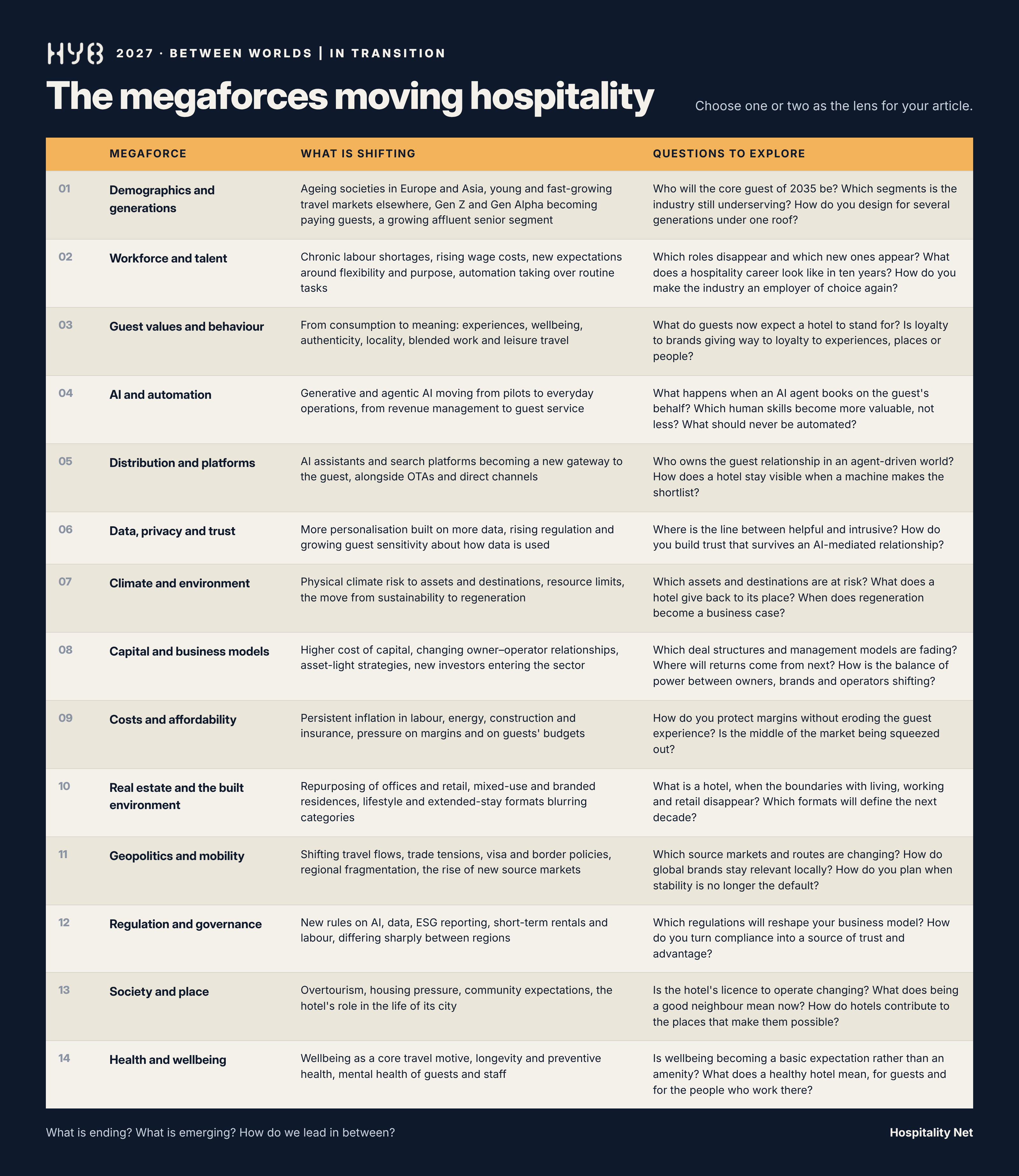
The HOTEL Yearbook is forward-looking, focusing on which forces will shape the industry's immediate future. This year's annual theme, "Between Worlds | In Transition," invites contributors to explore three central questions:
- What is ending? Which established practices, assumptions or business models are losing relevance?
- What is emerging? Which new approaches, opportunities or trends are taking their place?
- And how do we lead in between? Where should industry leaders invest, what should they preserve, and what should they be prepared to let go?
Below are some topics and themes that can serve as inspiration for your article.
- Click here to submit your article's theme/topic and format
Length, Title and Format
Your article should about 1,200 words.
Keep your title to 85 characters or fewer.
Choose one of the two formats below, Thought Leadership or Top-10 Trends, and follow its guidelines.
How to Write It
Focus On The Future: Our readers want to know where we are heading. Nobody has a crystal ball, but how do YOU think things will develop in your specific area of interest and expertise? Can you explain why you are expecting changes? What factors will be influential in shaping the future?
Be Personal, Informal, Conversational: We appreciate working with you as an author because we believe your perspective and insights are valuable. Our readers will likely share the same sentiment. The best articles in The HOTEL Yearbook tend to have an informal feel. So please break the journalistic taboo against saying "I" and feel free to express your ideas by freely saying "I think that...".
Style and Language: Use a language that is engaging, accessible, and avoids excessive jargon. Keep in mind that the aim is to enlighten, not to confuse.
No generative AI: We kindly request that authors refrain from using generative AI tools. These often produce generic content that fails to reflect the depth of their knowledge and expertise.
No Infomercials: Please note that articles may not refer to the author's companies or products by name or make product comparisons. The objective of The HOTEL Yearbook is to position its authors as opinion and thought leaders rather than promoters of specific commercial activity.
Exclusivity: The author guarantees exclusive publication of the article for Hospitality Net, with the understanding that it may also be shared on the author's company website or social media channels after publication.
Footnotes & References: The HOTEL Yearbook is not an academic journal, so please do not include footnotes or bibliographies. However, you may include hyperlinks to external sources in the body text of your article.
Format 1: Thought Leadership
Showcase your unique perspective and expertise by exploring a key issue or opportunity shaping the hospitality industry. This format allows you to present new ideas, provoke discussion, and demonstrate forward-thinking strategies that can help readers lead the way in their own organizations.
-
Purpose and Vision: Our goal is to produce articles that offer readers a distinctive perspective on the immediate future. All pieces should strive to highlight the implications of today's trends and events and project their potential impacts on the future.
-
Topic Selection: Writers should focus on subjects that are ripe for forward-looking examination. They should provide ample opportunities for educated speculation about future developments.
-
Fact-Based Speculation: Predictions and projections should be grounded in facts and informed by credible data. Sensationalism and baseless speculation will not be accepted. Where possible, articles should leverage expert opinions, scientific research, statistical trends, or historical patterns.
-
Clarity of Timescale: Identify the time frame being considered for the future outlook. The focus should generally be on the immediate future (up to five years ahead), but may also include a longer-term view if relevant to the topic.
-
Inclusive Future Vision: Articles should strive to consider multiple perspectives about the future, acknowledging the uncertainty and diverse possible outcomes. Avoid presenting a singular, deterministic future.
-
Imaginative Thinking: While articles should be rooted in fact, we also encourage creativity and visionary thinking. Writers are encouraged to explore new ideas, connect disparate dots, and challenge conventional wisdom.
-
Actionable Insights: The forward-looking perspective should aim to provide readers with insights that could inform their decisions. This could range from understanding policy changes, business strategies, and technological adoption to lifestyle choices.
Example: A New Age of Hospitality-Tech: Investment Booms and Maturing Technologies by Floor Bleeker
Format 2: Top-10 Trends
Spotlight the most impactful developments and innovations currently shaping the hospitality landscape within a specific area of the author's expertise. This format enables you to deliver a highly targeted overview of emerging trends and innovations, providing readers with an essential roadmap for what’s ahead.
-
Clear Theme Definition: The introduction paragraph should clearly define the theme/topic of your article. It should set the tone for the article and explain why this theme is relevant and important for the hospitality industry.
-
Consistency in Structure: Each article should follow a consistent structure, comprising an introduction, a list of 10 trends, and a conclusion. This uniformity helps in maintaining reader engagement and understanding. If you can’t provide a full list of 10 items, that’s perfectly fine—quality and relevance are far more important than quantity.
-
Relevance to the Theme: Each of the documented trends and innovations should directly relate to the theme/topic. Avoid including generic or off-topic advice.
-
Concise and Impactful Conclusion: The conclusion should succinctly summarize the key takeaways and reinforce the theme's importance. It should leave the reader with a clear understanding of how to implement the do's and avoid the don'ts in the context of the theme.
Example: Top 10 Trends Shaping Digital Marketing in 2025 by Chris Egan