

Lack of Feedback Is a Gift

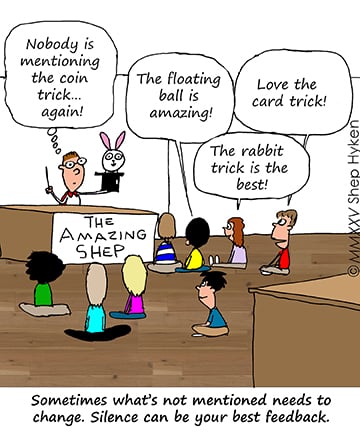 There’s an old expression: Feedback is a gift. Whenever a customer is willing to take time to share feedback by talking to you, emailing you, or leaving an online comment, it’s a gift. It either validates that what you’re doing is working or points out opportunities to improve. Companies obsess over survey scores and online reviews, and that’s smart. But if you only focus on what customers are telling you, you might miss important feedback that’s unintentionally hidden in what they don’t mention.
With that said, I’m going to flip this around and say that sometimes the lack of feedback can be as important as the specific feedback a customer shares.
It’s best if I share an example, and this comes from when I was 12 years old and had a birthday party magic show business. On a good week, I was performing at eight to 10 parties. About a week after every show, I would call the parents who hired me to perform for their child to thank them again and ask, “How did you like the show?” The answer was almost always positive. My father suggested I take it a step further and follow up with, “What magic tricks did you like the best?”
My father told me that over time, I would hear the same tricks mentioned. While that’s nice, what’s just as important, if not more so, are the tricks that weren’t mentioned. This unintentional silence can be a signal. His point was that if people aren’t talking about the tricks, replace them with tricks they will talk about. At the age of 12, I was learning an important tenet of customer service and experience, which is not only to ask for feedback, but also to operationalize it. In this case, it was to create and deliver a better magic show by paying attention to what my customers weren’t saying.
In any business, there are processes and experiences that customers encounter. If we’re customer-focused, we assume that what we’ve created delivers a good experience. Often, we’ll ask for feedback. Sometimes it’s about the overall experience, and other times it’s about something specific. All of that feedback should be appreciated, and while we need to pay attention to what customers say, we should also diligently pay attention to what they don’t say. That unspoken feedback may be the best feedback, and what’s so cool about this is that the customer doesn’t even know they are doing it.
Silence can equal insight. When customers seldom or never mention parts of your experience, ask yourself why. Whatever the reason, that silence may lead to your next big improvement. Look for the feedback customers offer, and look even harder for the feedback they don’t.