New Year’s Resolutions: Stop Doing These in 2026
The article presents 12 operational practices hospitality businesses should abandon, from over-relying on AI to treating customer service as a cost center.
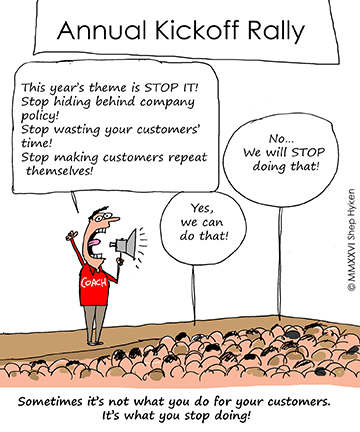 Happy New Year! This is the season when many people (and companies) take time to reset and prepare to kick off the new year. Some have already made their plan. Others choose to do it at the beginning of the year. It doesn’t matter when you choose to reset as long as you do it. So, for this first article, I’d like to offer up something to consider. Twelve New Year’s resolutions in the form of what you should STOP doing! (By the way, I recently wrote a similar article featuring five of these for Forbes. Read the article here.)
Before we get into the list, I went back over a year’s worth of articles, looking for the concepts I said we should do for our customers. Then I flipped them around and, instead of creating a list of resolutions to do, made a list of what to stop doing. So, here are a dozen resolutions that begin with the word stop:
- Stop trying to WOW every customer: To WOW the customer at every interaction is impossible. Instead, focus on consistent, predictable experiences that build trust and confidence with your customers.
- Stop wasting your customers’ time: Wasting a customer’s time sends the message that you don’t respect them. A generic example of this is when you call customer support and, while waiting on hold for an unreasonable period of time, you hear a message repeated: “Your call is important to us.” Obviously not!
- Stop thinking AI is the answer: The company that thinks they can eliminate the customer support department with AI-fueled customer service is quickly finding out they can’t. AI is an answer, but not the answer. It takes a balance between AI and humans to create the best customer service experience.
- Stop making customers repeat themselves: Pay attention to what the customer is saying the first time. Take notes, so if they call back or talk to someone else, there’s a record, and the customer doesn’t have to start over.
- Stop hiding behind company policy: It still surprises me to hear employees say, “That’s company policy.” When used the wrong way, those three words are customer loyalty killers. The policy should be to find ways to ensure customers come back.
- Stop treating customer service as a cost center: When done well, customer service keeps customers coming back again and again. That’s marketing. When the ROI of your customer service reduces churn and adds to the bottom line, it’s a revenue generator.
- Stop using acronyms and company jargon: Using initials and words used on “the inside” of a company may make customers uncomfortable. When they don’t understand or are confused because of what you say, you have to work hard to earn back their confidence.
- Stop thinking surveys give you the best feedback: I’m a fan of surveys when done the right way. They get your customers’ feedback, but perhaps a better source of that important information is your front line. So, recognize frontline employees as a valuable source of customer feedback.
- Stop thinking “We’ve already put our employees through customer service training”: Customer service training is not something you did. It’s something you do. It takes ongoing reinforcement of your original training to keep good employees customer-focused.
- Stop thinking loyalty programs create loyalty: There are a few loyalty programs that create true customer loyalty, but realize that loyalty programs are usually marketing programs focused on getting customers to come back. There’s nothing wrong with that, but remember that repeat customers aren’t always loyal customers.
- Stop assuming that if your customer doesn’t complain, they have nothing to complain about: Customers don’t always complain to you, but they will complain about you to their friends and colleagues. Silence does not necessarily mean happiness.
- Stop solving problems, and start solving customers: I recently interviewed David Fuhr, the chief sales officer at Sweetwater, for an upcoming episode of Amazing Business Radio. When we were discussing problem-solving and complaints, he said, “We solve the customer.” He went on to say that you first solve the customer, as in resolving the issue and winning back their confidence, and then you work with the team to find out why there was a problem and how it can be prevented from happening again. That’s a perfect example of being customer-focused.
And there you have it. Twelve ideas of what to stop doing. There are many more, and not just from articles that I’ve written. Take a look at the processes that impact your customers. What do they complain about? Create your own list of what to stop doing. It’s not just what you do. Sometimes it’s what you don’t do that gets customers to say, “I’ll be back!”
Comments
Comments for this content
0 comments available