Business Intelligence Tools and Decision Making for Hospitality
The article explores how hotels can leverage data analytics and BI tools to transform operational data into actionable insights for revenue optimization and strategic decision-making.
Business intelligence capability refers to an organization’s ability to collect, process, analyze, and utilize data to support strategic and operational decision-making. It is what experts refer to as a meta-construct that integrates digital technologies, artificial intelligence, and human judgment to transform raw data into meaningful and actionable insights.
What you need is clean, consistent data in every system involved, carefully defined to allow meaningful interpretation. This in turn can produce a sophisticated consolidation of tools to combine it into a single, cohesive database. Business intelligence can also be described as tools and processes that collect, analyze, and visualize data to support operational and strategic decision-making. These data are attached to reporting and analysis tools and all with a strong management commitment to process improvement.
Hospitality BI
Hoteliers are no different from the rest of us, buried under the huge amounts of operational data. No wone wants to generate hundreds of pages of anything with the expectation that you still need to read all the data to be able to make decisions. The key is to think simply with any of the readily available market and or management data. Business intelligence, in the hospitality business, can become actionable analytics and insights which in turn support ownership groups and management teams when it comes to making the right choices in processes that increase revenue and grow sales.
For example, in the course that I teach we focus on hotel market data and students are overwhelmed at the “all the numbers.” They are just beginning and they have not begun to analyze and interpret. With help from BI, managers and supervisors, one can understand customer travel and spending trends and patterns. With insights into historic trends, future actions can be anticipated with more accuracy allowing for better forecasting and budgeting. In my course I require the students to forecast growth rates for room nights form the current competitive set through the opening of a proposed hotel. This semester the base year is 2025 and the expectation is that it will take 2 to 3 years to build and open a proposed hotel. A proposed hotel could, all things being equal in 2028 (maybe). Then the room night forecasts look at the first five year of operation, 2028-2032. Therefore, the students need to have growth rates for seven years.
The students are now researching and collecting data for use in forecasting future room night demand for a specific market. As an example, identified data is utilized in an example below. Think about the research and input needed to create this analysis for a student and then amplify it for an operator. In the example below, the leisure segment, five years data was collected, and each indicator needed to be weighted and justified in relationship to its impact on room night demand. I will not go through the math, but the question for the students is, what does it mean and what decisions will this analysis yield? Broadly the decisions in this process are what economic indicator data should be used?, and in this case two ferry traffic data sets and a geographic food sales data, each weighted (subjectively: another decision-making process) for their impact on room night demand. The time frame was 2021-2025 and then a total forecasted growth rate for leisure travelers calculated.
Economic Indicators Forecasting Growth Rates is illustrative of the process.
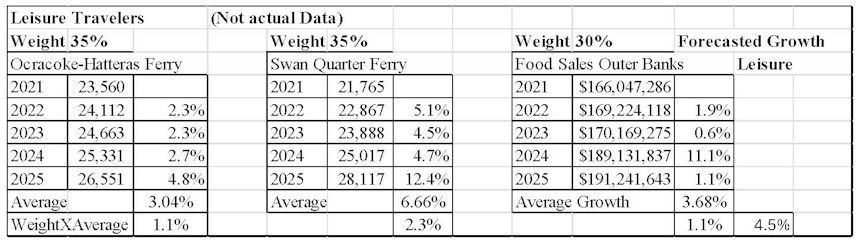
I use this as a simple example for one problem of many that our students must research, analyze, and forecast in a project scenario. This example is illustrative of the beginning of the complexity of analyses to come, for soon to be managers transitioning into industry professionals. In a broader framework, there are four keys steps that business intelligence follows to transform raw data into easy-to-digest insight for everyone in the organization to use.
-
Collect and transform data from multiple sources.
-
Uncover trends and inconsistencies: Data mining, or data discovery, data modeling and analytics—including exploratory, descriptive, statistical, and predictive.
-
Use data visualization to present findings.
-
Act on insights in real time.
Applying Hospitality Business Intelligence
Howard Dresner in 1989 coined the term business intelligence (BI) to represent concepts, techniques, and processes for enhancing business decision-making using optimized information. Other scholars perceive BI as a platform for integrating knowledge management, utilizing data collection, storage, and analysis to provide complex analysis through various analytical tools, enabling decision-makers to access viable information. BI is also described as an assortment of technologies and technical applications that can be used within an organization to integrate, structure, and streamline the analysis of extensive datasets. BI has also emerged as a dominant area of global investment in information technology, particularly within data-intensive industries like tourism and hospitality.
Some experts recommend that tourism and hospitality firms should systematically embed BI use cases into key business processes, such as customer relationship management, revenue management, and demand forecasting, to make BI a key element of their strategic and operational framework. The alignment of focused operating systems and technology enables tourism and hospitality firms to leverage digital tools more effectively, enhancing operational efficiency and customer-centric decision-making.
BI represents meta-capability, allowing firms to reconfigure their assets and capabilities in alignment with evolving business landscapes. Hospitality and tourism are sectors where real-time responsiveness, agility, and the capacity to derive actionable insights from vast volumes of data are essential for maintaining competitiveness. Hotel business intelligence is essential for making informed, data-driven decisions. The unique nature of the service industries requires ongoing knowledge of guest preferences, booking information, occupancy, average room rate, market segment share, REVPAR, and operating results. That content data and applied analysis via BI process systems and software will support an owner and their management teams with decision making tools that can yield effective and efficient operations.
For hotels, BI connects multiple data sources, such as revenue management systems (RMS), property management systems (PMS), booking engines, marketing platforms, and point of sale systems (POS), to provide a complete view of hotel performance. By analyzing historical and real-time data sets, hoteliers and hotel management teams can identify trends, anticipate demand, and adjust operations and pricing to drive revenue and guest satisfaction.
Planning for Business Intelligence Processes
Planning questions for your organization initially include: what data do you want and why, and can you get that data? If you get the data you wanted then what do you expect to do with it? For example, operators might want to forecast event and or meeting attendance, and be able to estimate what attendees spend at the meeting or conference. Ultimately allowing a hotel to forecast revenues per group.
These data could include data from CoStar . For example, our program is a member of CoStar’s SHARE Center, and we can secure trends and pipeline data for the markets we are examining. These data include aggregated rate, occupancy, census, revenues, and REVPAR. Additionally, data analysis can also be used to identify trends, patterns, and actionable insights. Advanced forecasting tools can predict demand changes and fluctuations and in turn adjust rates in real time.
To best utilize BI tools operators must plan what data you want and what will you want to do with it. BI tools help optimize pricing strategies through dynamic pricing. By evaluating occupancy trends, seasonal demand, competitor rates, and historical performance, hotels can set the right price for each room, maximizing average daily rate (ADR) and revenue per available room (RevPAR). BI tools can also analyze guest preferences, feedback, and as previously noted spending habits, allowing hotels to deliver personalized services. Additionally utilizing BI tools needed labor can be better forecast. Hotels can leverage labor forecasting to accurately predict staffing needs based on historical data, upcoming events, and seasonality.
Data collection, inclusive of internal data from POS systems and booking engines, market data on pricing and trends and guest data for preferences and behaviors can be enhanced by good BI tools. For example, a modern cloud-based PMS for revenue managers, can assemble performance data and allow managers to make fast, informed decisions without switching between multiple systems.
Going Forward
Implementing business intelligence strategy for hospitality requires planning, effort, and the assumption of some risk. Harnessing the vast amount of data generated daily is daunting. Many operators have not embraced BI or any new technologies. These operators have things going okay and progressing but are hesitant to make changes and therefore assume risk. The fear is that in today’s fast paced business world, data is the new currency. Experts note that those who fail to adapt risk being left behind by their competitors. Think of the potential advantages to gain the competitive edge, optimize revenue, and improve efficiency and guest satisfaction are the rewards for willingness on take on a little risk.
-
What are your objectives and priorities?
-
What types of data is needed?
-
What are the right BI tools? That is assess the BI platforms to better understand what you want and what you need to do and how a platform can support you.
Through this discussion it is hoped to provide resources and references for options for platforms. Note, I do not have recommendations. In the end you as the operators need to make decisions that best suit your operation’s needs. Do your research and examine the content and tools available.
Planning for BI
Think about the decisions you need to make and the decision-making models you utilize. Shared here is a model adapted from a Reflective Judgment model shared below. This model is utilized in courses as suggestions for decision making reasoning. The model focuses on the uncertainly of problem solutions and differentiates well-structured and ill-structured problems.
The industry case supporting hospitality and BI is that operating a hotel or another hospitality business would clearly require an ability to reason through ill-structured problems. Your homework is to pick an issue or problem that needs to be improved or solved and reason whether it is ill-structured or well-structured and then develop a BI plan. Shared is a Decision-Making Framework, used to support decision making in my courses. Presented as well structured versus ill-structured problems. Well-structured problems can be described with a high degree of certainty and completeness, and experts generally agree.
Educationally, the goal is to learn to reason correct solutions. Ill-structured problems cannot be described with completeness or certainty, and there is much disagreement about best decisions and solutions. The educational goal here is to construct and defend reasonable solutions.
Decision Making Process-Framework
-
Identify and Issue: Is it a well-structured or ill-structured problem? What data do you need and what do you want to do with it? Research the issue, for example, what BI tools do you need and what platforms will match with the organization?
-
Collect facts and evidence on data and tools. What are the facts? Which decision-making tools are most relevant.
-
Make a judgment or decision and then speculate on alternative results and perhaps collect additional facts. Define possible outcomes of alternative decisions.
-
Identify what role, an individual’s experience in the workplace plays in the decision. Perhaps weighing experience(s) in similar situations.
-
Evaluate the evidence: Are you asking the right questions? Decide what criteria you should use to weigh the evidence. Which are the more important decisions?
-
Reach a conclusion (judgment, decision).
This process can and perhaps should be ongoing. To briefly add to this process for your research, also identify data resources that your operation trusts to provide objective and solid recommendations. In my research and readings, I note the Hotel Tech Report as a referral source.
Hotel Business Intelligence Best Practices
Hotel business intelligence best practices involve using data and technology to guide smarter decisions in hotel management, improving guest experiences and profitability. This means understanding not just how many rooms are filled, but why certain patterns happen, and ensuring that all hotel teams use reliable, actionable information. To break this down, it is suggested that hotels track spill and spoil, that is measure empty rooms and lost booking opportunities separately to identify where pricing or marketing strategies might need adjustment.
It is also recommended to examine brand leaders that are known for BI as points of reference, also consider independent properties that are utilizing BI tools. For example, Marriott International with its multiple brands is a leader in BI utilization. Additionally, Hilton Hotels is also a player in the BI arena. Other hotel organizations noted in my BI research readings include Rosewood Hong Kong, Taj Hotels and a noted independent property, Inn at the Market.
Wrap Up
The hospitality industry has traditionally been driven by customer loyalty. It should be noted that some experts feel that the hospitality industry is quickly becoming a leader when it comes to business intelligence. Therefore, BI can serve as a means of preserving existing customer loyalty while facing competitive pressures.
To make BI important all of this requires a commitment from the executive team. "Everyone on the team has (his or her) own area of expertise, and it takes work to create a common vision, and then hold each accountable for the data quality. As noted previously BI refers to a set of methodologies, technologies and processes designed to transform data into useful information for decision-making. It is stressed that BI is the combination of practices, abilities and technologies used by companies to collect and integrate information, apply business rules and ensure the visibility of information for a better understanding of it.
Business intelligence analysts transform raw data into meaningful insights that drive strategic decision-making within an organization. BI tools enable business users to access different types of data, historical and current, third-party, and in-house, as well as semi structured data and unstructured data such as social media. Users can analyze this information to gain insights into how the business is performing and what it should do next. According to CIO magazine, “Although business intelligence does not tell business users what to do or what will happen if they take a certain course, neither is BI only about generating reports. Rather, BI offers a way for people to examine data to understand trends and derive insights.”
A recommendation is to build cross-functional relations and create inter-departmental connections with sales, marketing, finances, and operations throughout a hotel. Finally, it is stressed that the hotel industry is still about service. Value and price are important factors and operators embrace a need for technology, that is evident.
My recommendation is to look at the service framework for businesses as a function of price and value and then define authentic hospitality noting its role as the industry’s overarching framework. For example, I offer the following conceptual definition that is one definition: “Authentic Hospitality” is sincere and as easily given as a smile. It can be formal but not mechanical and is welcoming and helpful.
Authentic hospitality is demonstrated in the service we provide and connects us to a concern for our guests, our co-workers, our communities, and our business goals" The combination of a price, value and service culture with BI tools and platforms can help to create a path for increased success.
Reprinted from the Hotel Business Review with permission from www.HotelExecutive.com.
Comments
Comments for this content
0 comments available