HumanX Summit 2026, Day One: Seven Things That Actually Stood Out
Day one coverage from the HumanX 2026 summit at EHL Lausanne distills ten cross-industry interviews into six arguments: AI consensus, luxury redefinition, labor honesty, guest memory, divergent threat readings, and broken metrics.
HumanX is built around a deliberate provocation. The future is not technology or humanity, but technology and humanity. Care and connection are not soft skills, they are strategic inputs. Hospitality has things to learn from healthcare, finance, retail, gastronomy and beyond, and the rest of those industries have things to learn from hospitality. With 800 speakers and attendees gathered at the EHL campus above Lausanne for two days, the theme this year is Leading with Humanity, and the agenda is built to test that idea rather than celebrate it. The lunch hall was full, the corridors busy, and the cross-industry mix in the lineup gave the event its character.
The Hospitality Net team is on the ground for both days as official media partner, with Simone Puorto running back-to-back interviews with the speakers driving the conversation. Ten interviews on day one, including a sit-down with Jean-Jacques Morin, Deputy CEO of the Accor Group, plus a separate long-form conversation with hospitality technology veteran Michael Levie. Another round on day two. The questions go further than they would at a trade show, because the answers can. This is not a recap of products. It is a recap of arguments that moved a few inches forward this week.
Ten conversations, one shared closing question at the end of each. Where is the balance between technology and humanity most difficult to keep, and can you give an example? The answers form the spine of what follows.
1. Where AI actually goes, according to almost everyone we spoke to
This was the most striking thing about day one. Across ten interviews with neuroscientists, hotel CEOs, World Economic Forum directors, social entrepreneurs, designers, brand operators and data scientists, every single speaker described the same operational picture in different language. AI should handle the transactional and repetitive work. Humans should handle the moments where humanity is the point.
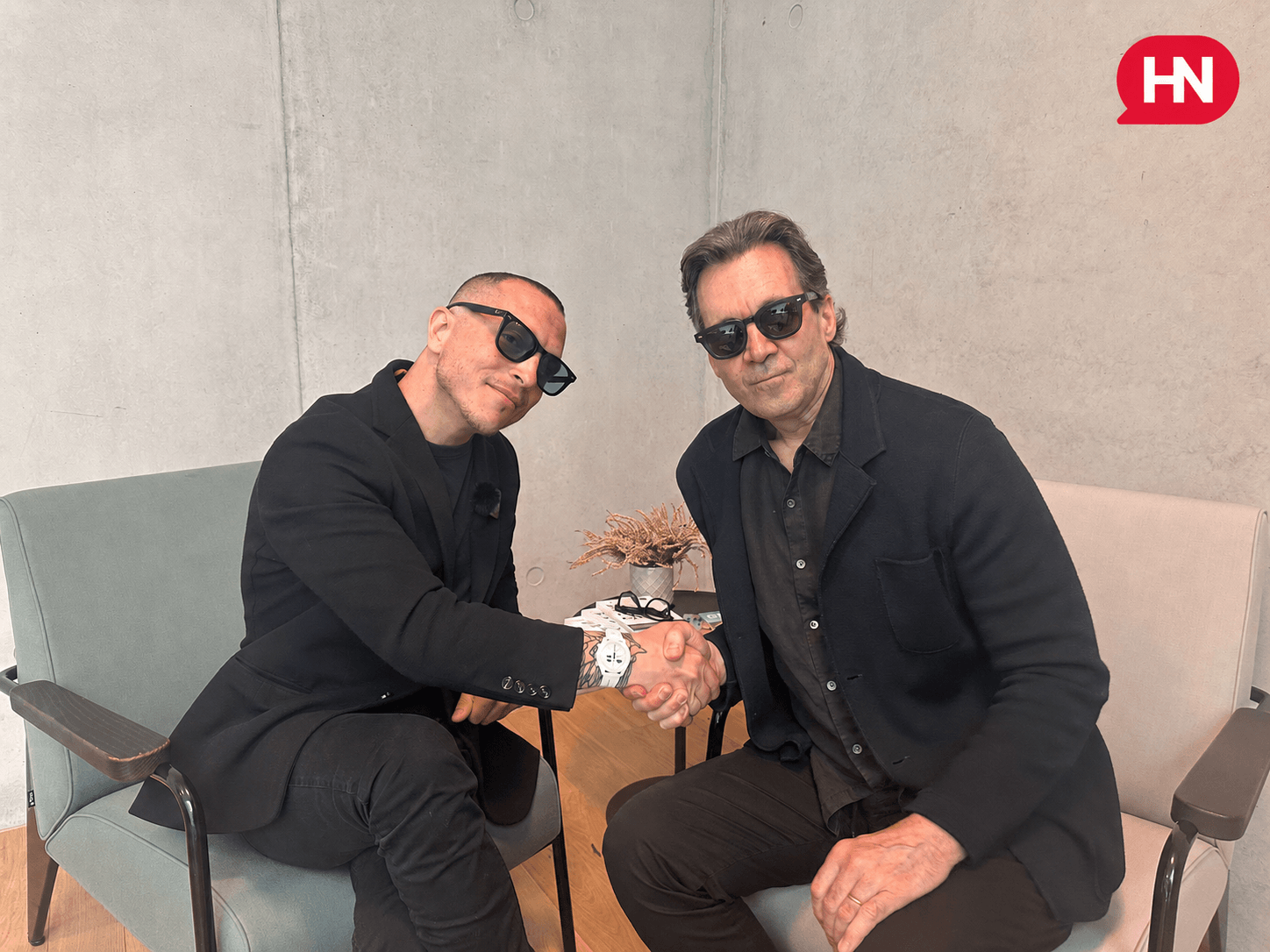
Christopher Norton at Equinox Hotels (pictured above) called it transaction versus pleasantries. Andrea Monti at EHL Next described moving the service from behind the reception to in front of it. Anna Nash at Explora Journeys wanted technology to stay invisible behind the team, leaving the eye contact and the genuine smile at the front. Mirko Lalli, twelve years inside travel data, put it most plainly. Use AI for everything that can be done with AI. Leave human for the magic. The convergence across radically different industries was unusual, and worth noting.
2. Luxury is being redefined as the thing that LLMs cannot reproduce
If the AI question produced agreement, the luxury question produced something more interesting. Four speakers reached for four different definitions of where luxury goes next, and each pointed in the same direction.
Norton's principle is unchanged. Luxury must be rare, but what counts as rare keeps changing. In his parents' generation, a Sunday restaurant meal was the rare thing. In his own, cooking at home with a good bottle of wine is. Anna Nash made it about time, the most valuable commodity, and the proposition of Explora Journeys is to give it back through the removal of logistics. Mirko Lalli took it further. As AI makes everything else more abundant, human connection itself becomes the genuine scarcity, and the next definition of luxury follows from there. Morin, with the most senior view, put it bluntest. The warm body at reception is what separates a hotel from an OTA.
Four operators, four framings, all reaching past the language of product or amenity and toward the same underlying observation. What machines can produce in abundance is no longer where luxury can live. The category is being relocated, in real time, to whatever sits outside what an LLM can do. None of the four said this in those terms. All four said it.
3. Hospitality's labour reality is finally being talked about honestly
For an industry that has spent decades calling itself a people business, hospitality has been remarkably reluctant to talk about what the work actually does to its people. That changed on day one.
Maria Haggo, a neuroscientist who built her career inside Ritz-Carlton spas before moving into brain-health consulting, named the badge-of-honour exhaustion culture hospitality should have outgrown decades ago. Lunch is for wimps, sleep is for the weak, push through. The neuroscience, she pointed out, says this is depletion theatre. Norton independently said the same about himself, recalling when four hours of sleep was a professional badge. Laura Sileo Pavat was blunt about the structural reality. Her bartenders in Cognac are shaking cocktails while their friends are exploring the towns.

Bernold Schroeder (pictured above), who led Kempinski through the pandemic, made the most operational version of the argument. The language matters, he said. Human resources implies extraction. Human capital implies investment. He recommends five to seven percent of payroll spent on training, and 150 to 200 hours per employee per year. Those numbers are well above industry norms, and he was direct about why they pay back. People stay. Productivity rises. The recruitment treadmill slows. None of this is a new problem. It is a problem hospitality usually prefers to discuss only in private.
4. What guests actually remember is people, not product
The most operationally precise version of this observation came from Laura Sileo Pavat. More than ninety percent of TripAdvisor and Google reviews on Pernod Ricard's brand homes mention the name of the guide. They are not trained to encourage that. It just happens. Pernod Ricard runs more than twenty countries of brand homes attached to its premium spirits portfolio, and the data is unambiguous.
The same observation surfaced from other angles across the day. Maria Haggo said authenticity cannot be faked because the nervous system can sense it. Anna Nash said the thing AI cannot replace is the eye contact and the genuine smile. The asset hospitality consistently under-measures is the asset LLMs cannot reproduce.
5. The senior people in the room cannot agree on what the AI threat actually is
Three speakers, three different readings of what AI is doing to hospitality. Mirko Lalli, with the data to back it up, described an algorithmic collapse already underway. Wikipedia traffic is down twenty-three percent year-on-year, with 1.6 billion fewer monthly visits in the last two years. Some destination websites have lost sixty-three percent of their organic traffic. Eighty percent of suggestions inside large language models, when sixty percent of travellers are now using AI to plan their trips, come from OTAs. Hotels and destinations are being erased from the discovery layer while they argue about other things.
Morin, sitting at the top of one of the world's largest hotel groups, read it differently. AI will reshape every industry it touches, but hospitality's operational core, the warm body at reception, is structurally more resistant to substitution than the work of coders, lawyers and accountants. The threat is real but unevenly distributed across the value chain. Schroeder gave a third reading. The technology is not really the variable. The variable is whether the culture around the technology adapts quickly enough. Asia, the Americas, the Gulf will move fast. Parts of Europe will not. Some companies in Germany, he pointed out, still run on fax machines. Three of the most senior voices in the room, three different reads on where the pressure is actually coming from. An operator has to pick one to plan against.
6. The industry's metrics are wrong, and the industry knows it
Andrea Monti at EHL Next made the analytical version of the problem. Hospitality still measures itself with industrial metrics, ADR, RevPAR, occupancy, at a moment when the real questions are about guest experience, workforce wellbeing, and impact in society. There is a narrative that AI will free time for employees to spend with guests. Prove it, he said. Let the operators measure it.
He was honest about why the gap exists. In Paris, Milan, Berlin, Shanghai, hotels are at eighty-five and ninety percent occupancy every weekend. The system is not under pressure to invent new metrics. Cash is king, and cash is flowing. Christian Hürlimann, the new Director of HotellerieSuisse, surfaced the everyday operational version of the same problem. He arrives at a hotel he has stayed at four or five times before, and the receptionist asks if it is his first visit. The industry argues about AI strategy while losing its battle on guest recognition fundamentals it has had thirty years to solve.
7. Inclusion is not a marketing word, and hospitality keeps designing for the wrong user
Kelly Ommundsen, who runs digital inclusion at the World Economic Forum and has connected over a billion people to affordable digital services through the EDISON Alliance, put the sharpest edge on the technology conversation. The problem with hospitality's digital transformation, she said, is not the technology. It is that the industry consistently designs for the super user, the tech-fluent twenty-year-old who knows how the loyalty app works.
Her example landed harder than any policy framing could. Her father does not own a smartphone. If a hotel asks him to download an app to check in, he is lost. Her mother has Parkinson's. If the lobby is built around a kiosk she cannot operate, she will not make it to her room. Technology is not good or bad, she said. The transformation makes things different. The variable is who is in the room when the design decisions get made.
The recurring question, and the answer that stayed
At the end of every interview, Simone asked the same closing question. Where is the balance between technology and humanity most difficult to keep, and can you give an example? Ten answers came back, all worth their thirty seconds of camera time. One stayed with us.
Jean-Jacques Morin came to hospitality after thirty years in audit, semiconductors and rail engineering. Deloitte, then Motorola, then Alstom, before joining Accor in 2015. He now runs the Premium, Midscale and Economy division at the world's third-largest hotel group. When the closing question landed, he did not reach for a clever framing. He named the underlying physics of the moment instead. This wave is now hitting, he said, and it is not going to stop. The people who lose will be the ones who reject it. The people who win will be the ones who understand how to surf it. Roughly seven hundred billion dollars, as Morin put it, is going into AI infrastructure this year from the top five technology companies alone. ChatGPT will pass one billion users this year, from close to zero three years ago.
The wave is not going to stop. The question for hospitality is how to engage with it without losing the warm body at reception.
Coming up
Day two brings another round of interviews and a different mix of voices, with leaders from luxury hospitality, regenerative tourism, hospitality design, gastronomy, and beyond. Same closing question. Different starting points. We will let you know what stays.
The full interviews from both days, including the long-form conversation with Michael Levie, will start appearing on Hospitality Net from the end of next week, two a day so they have room to breathe. Make sure to check back. The conversations went further than these summaries can capture.
A final note. None of this would have come together without the warmth of the EHL team and the student volunteers who looked after us throughout. Thank you!
Comments
Comments for this content
0 comments available