Expert Views (14)

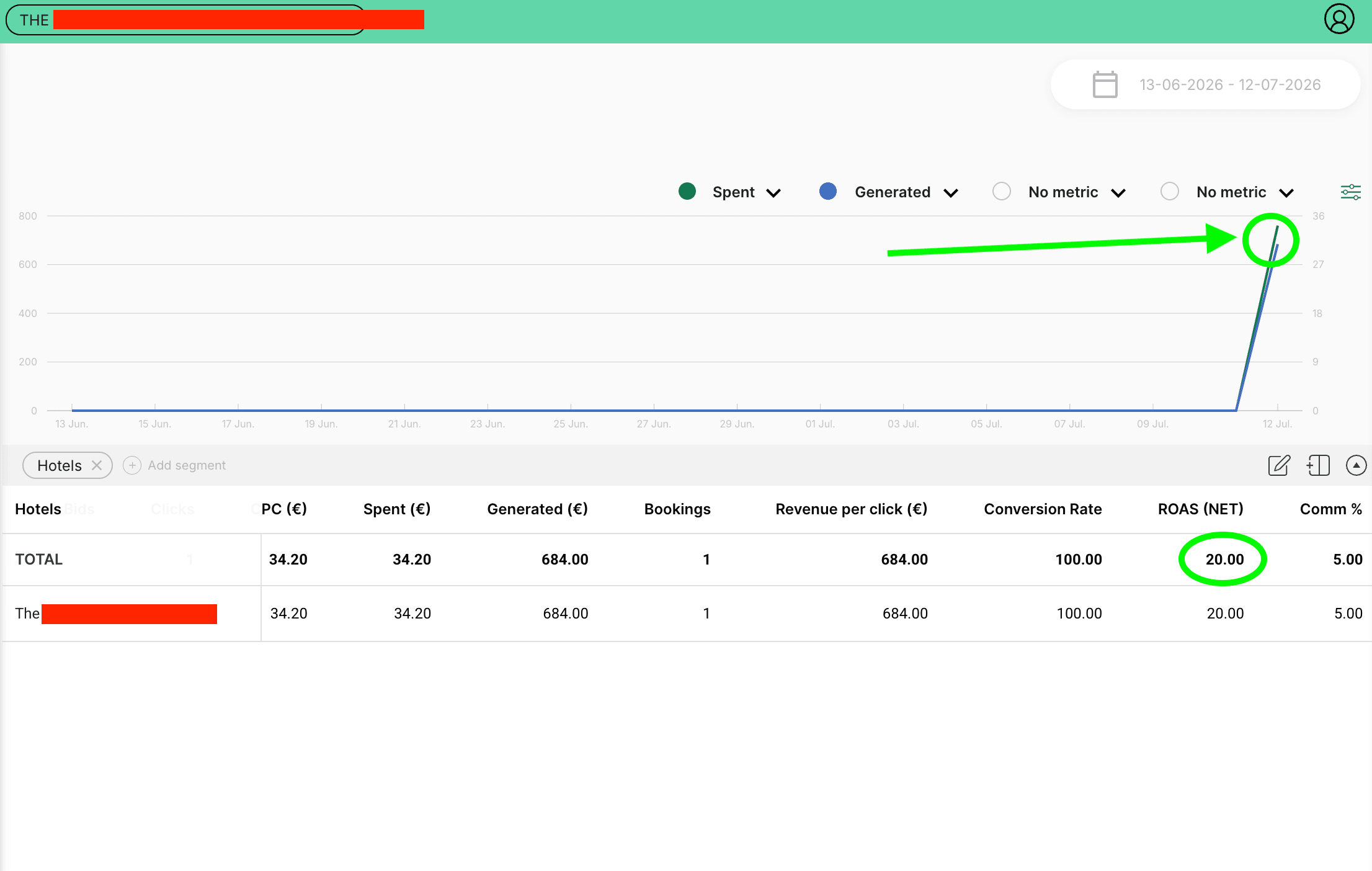
The booking itself isn't the important part—it's the fact that it can be fully tracked from an AI conversation to a completed reservation.

Right now, AI advertising generates very little volume, but every new channel starts small.

Hotel metasearch followed a similar path before becoming a major source of direct bookings.

AI could go even further because it helps travellers discover hotels, not just compare prices.

Instead of searching, clicking and comparing multiple websites, people may eventually book through one conversation.

If that happens, AI will become both a discovery tool and a booking channel.

Hotels will need to make their prices, availability and hotel information easy for AI to understand.

It's too early to draw conclusions from one booking, but it's an interesting sign of where hotel distribution could be heading.

The real milestone isn't the ROAS—it's proving that an AI conversation can lead directly to a measurable booking.

The initial response—cool!

How gratifying to witness this given all your years in this space.

I was at Google last week hearing firsthand how digital advertising is evolving in this new search era.

By comparison, Metasearch aggregated rates and redirected intent. Conversational AI advertising is the evolution from search engines to direct transaction engines.

Three structural shifts drive this:

Google’s AI Mode Pivot: Core ad capabilities—Booking Ads and Hotel Feeds—are migrating directly into AI Mode. In conversational search, "Ads must be answers."

UCP as Transaction Engine: Google’s open Universal Commerce Protocol (UCP) for Lodging bridges discovery to settlement natively. UCP standardizes real-time ARI, preferences, and payment tokenization—ensuring hotels remain Merchant of Record and retain guest data.

Capturing Real-Time Demand: Native Brand.com presence builds trust and click-throughs. Combined with dynamic pricing and bundling, AI ads function as real-time yield management.

Metasearch optimized the click; AI ads, powered by UCP, optimize the transaction journey. Operators waiting for "volume" before acting will eventually be locked out of a marketplace where the search box no longer exists.

Booking.com just recently shared that only 1% of their revenue is presently generated via AI traffic. Doesn't seem like much, and at first glance this low figure seems to corroborate the view that AI is primarily a top- and mid-funnel channel. But behavior towards AI is shifting so quickly that we should contemplate all the possibilities.

Earlier this year, reports showed that in North America, one in every two consumer now uses AI for search. And in travel, it's 56% of travelers that now use AI for planning. The gap remains between the planning and booking phase, but as people get familiar and comfortable using ChatGPT, Claude, Copilot or Gemini on a daily basis, booking on these platforms represents a natural evolution.

Will it become a predominant sales channel? Not so fast. Just look at social media, where many thought they would become conversion tools, yet they remained mostly conversational. But can AI reach 5%, 10%, 20% or perhaps more of total online bookings? I certainly think so, and AI ads will most certainly play a role in this equation.

Measuring ROI and ROAS will remain key, and perhaps the biggest challenge. But this reality seems inevitable.

A first AI-attributed booking is evidence that the channel became measurable, not that it became transactional. Incrementality comes before return.

A paid AI placement arrives carrying an identifier, which is what makes a journey connectable. The unpaid version carries no identifier: assistant sessions arriving without a referrer land in GA4's Direct. The asymmetry is structural, so the AI-attributed number grows with spend before it grows with traveller behaviour.

Live prices in an assistant require an ARI push of rate plans, amounts, availability, restrictions and inventory counts, the same connectivity Google Hotel Center takes for metasearch. The buying side is easy now, with OpenAI's Ads Manager opened in beta on 5 May 2026 and Google's Ads in AI Mode announced at Marketing Live 2026. If you run metasearch you already have the hard half, and that is one way this channel can follow metasearch's path.

Metasearch's stretch is worth expecting too: bidding on your own name both defends the direct channel and harvests demand that would in part have converted anyway, and separating the two has never been settled cleanly.

So run it as a holdout, and read the attributed revenue as a measurement artefact until the test says otherwise.

My view is that the metasearch era is approaching its structural limit. Its architecture, dozens of disaggregated sources, SQL filters exposed to the public and a large cached database sitting behind them, was never designed for personalisation.

The user has to do the work. Try telling a metasearch that you are a couple, one child and a dog. Very often the data does not even carry the property child acceptance policy in a queryable form. Tech stops at database mapping and integration flows, many of which still run on XML.

Transformer generative models change the economics of that problem. They handle structured, deterministic information exactly as metasearch does, and they can also surface information that wasn’t modelled as a field, such as child policies or anything guest centric. On personalisation, AI has far more room to scale towards the end user.

What these systems still lack against the firepower of Google Hotel is not intelligence but computational cost relative to the premium they return. Transformers consume too much even before true personalisation enters the picture. It is a cost curve problem. If GPU compute follows the trajectory CPU compute took, the path is already traced.

Reach out if you want to go deeper.

AI computing is exceptionally expensive and all AI platforms like ChatGPT need to monetize their traffic. Fast! How do AI platforms make money? Their primary revenue streams include paid individual subscriptions, tiered enterprise plans for businesses, and API access fees charged to AI application developers.

In travel, in addition to enterprise and API access fees, the fastest way to make money is a) earning affiliate commissions from OTAs, hotels and other travel suppliers, and b) advertising.

The problem with earning affiliate commissions is that very few people book through the AI platforms. Expedia’s survey shows that only 8% of travelers are willing to book via an AI platform or Agentic AI application.

So advertising remains as a very lucrative revenue stream.

Ex. ChatGPT has already copied Google’s Freemium Business Model, which Google copied from the Yellow Pages: free listings and sponsored/paid listings. This model permeates throughout Google’s Universe: Search, YouTube, GHA, etc.

Ads on ChatGPT appear as clearly labeled sponsored content or product carousels separate from organic text responses. They are served only to users on free and low-cost tiers (such as Free and Go plans), while paid tiers like Plus and Pro remain ad-free.

So, AI platforms are becoming the new metasearch players

I think conversational AI is already a full funnel channel today. Our ability to measure AI driven reservations is improving, but connecting a full user journey from discovery to booking is still largely opaque and may remain so. The honest measurement isn't only ROAS, it's incrementality and with no user ‘keyword’ or ‘prompt’ data likely to be available to marketers we are working on assumptions rather than hard data.

In my opinion the sharper question is who/what will control the distribution and under what mechanism(s).

Every platform will approach ads differently. Google will lean on its existing ad systems, ChatGPT has launched self-service ads, and hotel price feed and metasearch providers are racing to plug into as many AI surfaces as possible.

If the technical requirements force hotels to use third party feeds and the models settle into commission or CPA structures, the analogy isn't exactly metasearch, it's more another form of OTA.

The space is evolving quickly and just this week Google announced new testing of agentic hotel bookings. We are likely to see more options appear that will suit a range of property types and marketing budgets and hopefully enable hotels to control their own distribution as much as possible.

Thank you, Simone, for sharing a successful example of AI ads. While a single booking cannot tell us whether this new channel will succeed, a 20x ROAS and 5% acquisition cost are certainly impressive. I find the attribution more interesting than the performance metrics. Simone’s case demonstrates that an AI-mediated interaction can be traced from conversation to transaction.

I see similarities with the early days of metasearch, but AI advertising could go further. Conversational AI can compress multiple stages of the booking funnel into one interaction. Travelers can move from inspiration and information search to comparison, live rates and availability, and eventually to booking, all without navigating multiple websites. AI could therefore evolve from an upper- and mid-funnel influence channel into a transaction channel.

For hotels, the opportunity is not simply buying another form of paid advertising. Success will also depend on accurate property information, competitive rates, real-time availability, and seamless booking connectivity.

The real test comes with scale. As more hotels compete for AI-mediated demand, acquisition costs will likely rise. If AI advertising continues delivering incremental direct bookings efficiently at scale, it could become more than just the next metasearch channel and reshape how travelers move from recommendation to transaction.

Metasearch works because the same hotel, for the same night, is sold by many players. They compete against each other, that’s where the auction comes from. The ad inside ChatGPT has no hotel, no date, no price. It’s a brand billboard under an answer. Right moment, yes. A marketplace, no really

And the real change isn’t advertising at all. Metasearch shows you twenty options and lets you choose. The assistant names three, and you’ve already chosen before you ever see a price. What changes isn’t who sells the space. it’s who decides the shelf. Which is why inside AI you keep finding the same three big names. The concentration doesn’t disappear, it just moves....

So the right question isn’t what a click on ChatGPT will cost. It’s who builds that list of three, on what data, and who can check it. When metasearch favoured itself, you could see it and challenge it. Inside an AI-written answer, you can’t see it anymore.

And today AI inspires, it doesn’t book. for a metasearch it’s a channel to buy, not an enemy. The day the assistant keeps you inside and takes the payment there, we won’t have a new ad format, we’ll have a new intermediary. 

Yes — but it won't look like metasearch.

Metasearch worked because it intercepted existing, bottom-funnel intent and monetized comparison: ten rates on one page, an open auction, a click you could price. Conversational AI compresses that. The assistant returns two or three options, not twenty, and the reasoning behind the shortlist is opaque. That's less an auction than a qualification game — winner-take-most, with far less inventory to bid on.

Which means the lever isn't budget. It's whether your ARI is connected, structured and machine-readable, and whether the descriptive content the model reasons over actually reflects the property. No CPC will rescue a hotel that the assistant can't parse or price. That's the real prep work, and it's cheap.

Two things I'd watch. First, the monetization model: if platforms drift toward transaction fees rather than clicks, this becomes an OTA-economics conversation, not a metasearch one — and the 5% COA won't hold. Second, attribution. Most AI-influenced bookings will land as direct or brand search. Your single tracked booking is the visible tip; the dark share is likely larger already.

So: participate now for the learning, not the volume. Don't reallocate budgets until the pricing model settles.

We don't know if AI Chat is really going to be the form factor that Intelligence will have in the future. Will it just be embedded into the OS? We know every system will have intelligence built-in just like they all have a graphic user interface. So considering that and the fact that it will be ubiquitous, I think we can safely assume ads in AI will be just like metasearch ads, and just like google search ads.

I think the most interesting part is not the 20x ROAS, because one booking obviously proves very little. What interests me is the signal behind that booking.

Metasearch helped travelers compare hotels they were already considering. Conversational AI could increasingly help travelers decide which hotels they should consider in the first place.

That is a very different proposition.

When someone tells an AI, “Find me a boutique hotel in Paris next weekend with a rooftop terrace,” they are providing more than a search query. They are providing intent signals. If AI can connect those signals with live rates, availability, reputation, experience and the characteristics that make a hotel different, we may be moving toward intent based distribution.

There is also a paradox hotels should watch carefully. Becoming AI readable does not automatically make a hotel AI recommendable. In fact, if every hotel becomes a perfectly structured collection of price, location and amenities, AI could make commoditization even easier.

So I believe the future question is bigger than whether AI Ads become the new metasearch.

The question hotels should be asking is: What signals are we giving AI that make it confident enough to recommend us?

Two missing features prevent AI from driving transactions today. The first is a validation layer, like the ratings and reviews that built trust for eBay, Amazon, and TripAdvisor and powered the birth of e-commerce. Without that trust, most consumers still use your property website, Google, and ratings/review sites to validate what AI has told them. 

The second missing feature is a mechanism for AI to monetize the traffic they receive. 

AI tools will need to address both to become a major driver of reservations and revenue.

Ads, especially bottom funnel ads, will be a major piece of solving the monetization puzzle over time. 

The goal for hoteliers is to ensure paid ads don’t simply replace free discovery in answers as AI companies take a bigger slice of the commercial pie. While metasearch is a useful channel, it also increases costs that used to come from “free” organic search. That same pattern will likely hold true for AI. 

Are “metasearch” ads coming to AI? You bet. To get ready, your team should audit your direct booking strategy so that as AI metasearch ads show up, you're winning direct guests, not just buying back reservations you get for free today.

I think we still have far too little traffic to draw any meaningful conclusions from AI advertising. One booking proves that the journey can happen and, importantly, that we can measure it. That's interesting, but that's about as far as I would go for now.

In the short term, I struggle to see AI becoming a significant bottom-funnel channel. We still need to solve many of the same integration problems we've been carrying around since metasearch: ARI connectivity, attribution, IBE integrations, payments, etc. So, for now, AI advertising remains primarily a top- and mid-funnel game.

What interests me much more is what comes after.

I can imagine a future where the very idea of brand.com + IBE feels archaic. Today we leave one interface, land on another domain, learn yet another UI, enter our personal and payment details, and repeat the process every time we book something.

Our children may look at this as Homo erectus behaviour.

Once I have told an AI where I want to go, when, with whom, what I want and how much I want to spend, why should I ever leave that interface?

At that point, AI becomes the UI.